Memorandum of Understanding for the Employment of the USCGAUX in Support of the National Recreational Boating Safety Program
At 1300, June 12, 1997, the formal signing of a Memorandum of Understanding for Employment of the U.S. Coast Guard Auxiliary took place in support of the Coast Guard’s National Recreational Boating Safety Program.
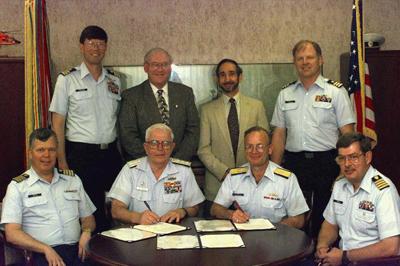
Left to right standing: CDR Ron Walters, Assistant Chief, Auxiliary Operations Division (G-OCX-2); Mr. John Malatak, Chief, Program Development and Implementation Division (G-OPB-2); Mr. Al Marmo, Chief, Program Management Division (G-OPB-1); CDR Tom Martin, Chief, Auxiliary Operations Division (G-OCX-2). Sitting left to right: CAPT Tony Stimatz, Chief, Office of Boating Safety (G-OPB); COMO Ralph Oberlander, USCG Auxiliary NAVCO-RBS; RADM James Hull, USCG, Director of Operations Policy (G-OP); CAPT Al Summy, Chief Director, Office of Auxiliary (G-OCX).
Objective
Through mutual participation and commitment, expand the involvement of the Coast Guard Auxiliary in a dynamic “Team Coast Guard” approach which actively engages Auxiliarists as full partners in aggressively supporting the Coast Guard’s National Recreational Boating Safety (RBS) Program.
Discussion
The mission of the Coast Guard’s Recreational Boating Safety Program is to minimize the loss of life, personal injury, property damage, and environmental impact associated with the use of recreational boats, through preventive means, in order to provide safe use and enjoyment of the U.S. waterways by the public.
The mission to reduce recreational boat fatalities is one of the Coast Guard’s strategic goals outlined in its agreement with the Department of Transportation under the auspices of the Government Performance and Results Act Performance Plan.
USCG Office of Boating Safety (G-OPB)
Program Goals
The goals of the Recreational Boating Safety Program administered by the Office of Boating Safety (G-OPB) include:
- Improve the demonstrated knowledge, skills, abilities, and behavior of boaters.
- Improve the safety of boats and their associated equipment.
- Improve the physical and operational boating environment.
- Improve intermodal and interagency cooperation, coordination, and assistance.
Program Functions
Under the direction and supervision of the Assistant Commandant for Operations (G-O) and Director of Operations Policy (G-OP), the Chief, Office of Boating Safety shall:
1. Act as Program Manager for the Recreational Boating Safety Program to fulfill the National Coordinator responsibilities defined by the Federal Boat Safety Act of 1971, as amended. The role of the National Recreational Boating Safety Program Coordinator requires that person to:
- (G-OPB-1, -2, -3) Maintain liaison with appropriate international, federal, national, state, and local partners.
- (G-OPB-2) Administer federal recreational boating safety financial assistance grants to states.
- (G-OPB-1) Administer the national non-profit organization grant program.
- (G-OPB-2) Promote uniformity and reciprocity in boating laws.
- (G-OPB-2) Monitor agreements between the Coast Guard and the states for boating safety.
- (G-OPB-1) Ensure state participation in national marine casualty reporting.
- (G-OPB-1) Provide executive direction for the National Boating Safety Advisory Council.
- (G-OPB-2) Oversee national boating safety outreach and awareness.
- (G-OPB-2) Oversee boating safety education standards.
- (G-OPB-3) Administer recreational boating product assurance programs.
Effectiveness Measurement
The program measures its effectiveness using data on fatalities, injuries, collisions, allisions, and cost per hour of passenger exposure.
Auxiliary Directorate of Recreational Boating Safety
The Coast Guard Auxiliary reorganized its national structure to align with the streamlined Coast Guard. Under the National Vice Commodore, the Directorate includes three departments: Boating, Education, and Vessel Examination.
The Auxiliary can perform any mission authorized by the Commandant except direct law enforcement and military duty.
The Directorate acts as a force multiplier for the Coast Guard’s RBS Program, supporting the same goals and metrics as G-OPB.
Direct Functions in Support of RBS
Boating (DC-B)
Provides liaison with state and federal boating safety partners and supports data analysis, program development, outreach, and guidance.
Education (DC-E)
Designs, produces, and delivers boating safety education to the public, improving knowledge, skills, and safe behavior.
Vessel Examination (DC-V)
Oversees the Courtesy Marine Examination program, outreach to marinas and dealers, and safety equipment awareness.
Effectiveness Measurement
Support will be measured by the quality of deliverables, schedule adherence, and responsiveness to G-OPB priorities.
Funding
The Chief Director, Auxiliary funds administrative and organizational support for the Auxiliary program. Program managers provide additional funding for mission-specific needs.
Agreement
Leadership from G-OP, G-OCX, G-OPB, and the Auxiliary RBS Directorate establish this Memorandum of Understanding and its addenda, which define mutual goals, responsibilities, and working procedures.
Action officers maintain, review, and update the addenda as needed and advise their respective offices on progress.
This Memorandum remains effective unless canceled in writing by either party and is reviewed annually.
Signatures
R. L. Oberlander
National Vice Commodore, USCGAUX
J. D. Hull
Rear Admiral, U.S. Coast Guard
A. D. Summy
Captain, U.S. Coast Guard
J. A. Stimatz
Captain, U.S. Coast Guard
Addendum #1
Department of Boating (DC-B)
Under the direction and supervision of the National Vice Commodore – Recreational Boating Safety (NAVCO-RBS), the Chief, Department of Boating (DC-B), provides support to the Office of Boating Safety (G-OPB) as follows:
- When directed, represent the Recreational Boating Safety Program.
- Act as liaison to the Auxiliary Department of Public Affairs for G-OPB/DC-A pertaining to the related activities of the annual National Safe Boating Campaign and National Safe Boating Week.
- Upon request, assist with program data requirements, collection, analysis, and dissemination.
- Assist in data collection:
- Conduct surveys and observations / data recording.
- Provide statistical expertise in survey design.
- Analyze data and present results.
- Perform studies.
- Review existing reports and studies for accuracy, lessons learned, and applicability to national programs.
- Promote reporting of boating accidents.
- Assist G-OPB with development and implementation of a program to provide recreational boating information to Coast Guard unit commanders. The program will provide unit commanders with general information about recreational boating safety, Auxiliary capabilities, state and local resources involved with recreational boating safety, and should include boating accident information.
- Develop, promulgate, and maintain a “National Guide to Auxiliary Usage.” The Guide will serve as a practical reference directing external customers on how to obtain information or services from the Auxiliary.
Addendum #2
Department of Education (DC-E)
Under the direction and supervision of the National Vice Commodore – Recreational Boating Safety (NAVCO-RBS), the Chief, Department of Education (DC-E), provides support to G-OPB as follows:
- Assist G-OPB in the development of educational standards applicable to boating safety classes and other educational outreach efforts.
- Represent G-OPB at meetings with federal, state, and non-governmental organizations (NGOs) when so directed.
- Serve as a beta test facility for educational products and standards developed by G-OPB.
- Assist in the dissemination of special program materials developed by G-OPB.
- Provide any other assistance as assigned.
Addendum #3
Department of Vessel Examination (DC-V)
Under the direction and supervision of the National Vice Commodore – Recreational Boating Safety (NAVCO-RBS), the Chief, Department of Vessel Examination (DC-V), provides support to G-OPB as follows:
Support to G-OPB-2
- Develop handouts for the Marine Dealer Visitation (MDV) and Vessel Examination (VE) programs.
- Build cooperation with dealers, marinas, and manufacturers.
- Assist with the personal watercraft (PWC) boat livery dealer program.
- Distribute product safety information and ancillary items as requested by G-OPB-3.
- Support DC-V staff in representing the program at selected meetings and conferences.
- Provide VE production and performance incentive awards.
- Provide a focal point for consumer response opportunities and survey data collection efforts.
Support to G-OPB-3
- Augment factory visits and training of Vessel Examiners for factory visits.
- Conduct outreach for marine dealers, marinas, and livery rental operators.
- Visit local small boat shows and local small boat manufacturers.
- Collect statistics from boat shows and record Hull Identification Numbers (HINs).
- Record and analyze Courtesy Marine Examination (CME) failure statistics.
- Investigate new applications for Manufacturer Identification Code (MIC) identification.
- Provide Vessel Examiners with recall information.
- Advise Vessel Examiners of standards changes.
- Ensure Vessel Examiners report defects or standards violations located in the field for investigation.